
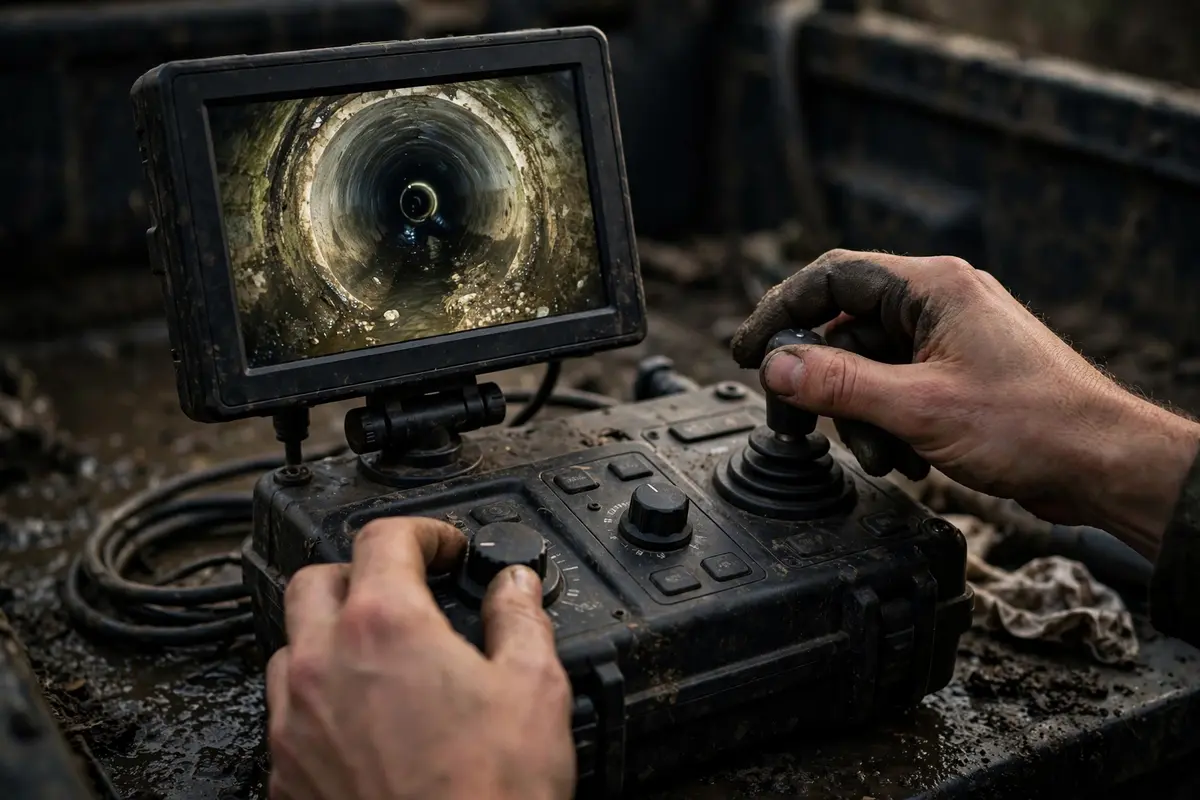
Camera diagnosis first
A camera run shows the crack, offset, belly or root mass on screen, with its location marked, so the repair targets the actual defect.
A sewer repair is only as good as its diagnosis. The camera comes first, the repair follows the footage, and the line is checked again before the job is called done.
A camera run shows the crack, offset, belly or root mass on screen, with its location marked, so the repair targets the actual defect.
A single bad section is repaired rather than replacing the whole line, when the rest of the line is sound. The footage decides, not a sales target.
Roots are cleared from joints and the joint itself is addressed, because clearing roots without fixing the entry point only buys weeks.
Replacement sections use pipe and fittings matched to the system and to the 2025 California Plumbing Code.
Fixtures are run and the camera goes back in, confirming the repaired section flows and the rest of the line is clear.
You keep a short written note on what the camera showed, what was repaired, and what the rest of the line looks like.
Sewer line repair in Anaheim is, more than most plumbing work, a story about pipe age. The city's flatland laterals are often clay or cast iron laid when the tracts went up in the 1950s and 1960s, and those materials fail at joints first: roots enter, joints offset, sections crack, and the line bellies where soil has settled. In the Colony, the oldest homes in the city carry even earlier laterals, and in Anaheim Hills, hillside access changes how a repair is reached.
Two things are deliberately not claimed on this page. What can be said plainly: a plumbing permit covers building-sewer work on private property, and the repair itself should follow the 2025 California Plumbing Code. Cost depends on depth, length, access and material; call (657) 680-4140 for a phone quote.
Five steps, in order, from the first phone call to a line that is verified clear.
Call and describe it
Tell us which fixtures are affected and whether this is a first backup or a repeat. Repeats point to a structural cause, not a simple clog.
Camera the line
We run a camera from the cleanout and record what it finds: cracks, offsets, bellies, roots, and the condition of the rest of the line.
Explain the footage
You see the defect on screen and hear the options: a targeted repair, a trenchless approach where it fits, or replacement where the line is beyond patching.
Repair the defect
The damaged section is repaired with pipe matched to the existing system, and the work follows the 2025 California Plumbing Code.
Sewer camera and locator
Shows the inside of the line on screen and marks the defect's location above ground, so digging lands on the problem.
Hydro jetting machine
Clears roots, grease and scale from the line before repair, at pressure matched to clay, cast iron or plastic pipe.
Drain cable and auger
Clears soft blockages and root masses in sections where jetting is not the right first move.
Excavation tools
Hand and machine digging sized to the repair, kept as small as the defect allows.
Pipe cutters and joining tools
Cuts out the failed section and joins the new pipe to the old line with fittings matched to both materials.
Compaction and backfill tools
Restores the trench properly so the ground does not settle into a new belly over the repair.
Camera-first, always
No repair is recommended without footage. The camera decides whether the job is a spot repair, a trenchless job, or a replacement.
Repair only what is broken
A sound line is not replaced to sell a bigger job. A failed section is repaired; the rest is left alone and noted.
Match the material
New pipe and fittings are matched to the existing line and to code, so the joint between old and new is not the next failure.
Verify after repair
Camera and flow checks after the repair confirm the fix before the trench is closed and the surface restored.
01
We camera the lateral and find an offset joint admitting roots. The joint is repaired rather than cleared again, and the rest of the line is assessed on footage.
Backups stop because the entry point is fixed, not just the roots, and the homeowner knows the condition of the remaining line.
02
We clear the main line, camera it, and find a cracked clay section. The section is repaired and the camera verifies the fix before backfill.
Fixtures draining normally, with footage of the repaired section and a note on the rest of the line.
03
We camera from the cleanout to find whether a break is leaking into the soil, and mark the defect's location before any digging is discussed.
A located defect and a repair plan sized to that one section, not a whole-yard excavation.
04
We camera the shared line to find whether the failure is in the common run or a branch, so the repair lands on the right section.
Both units draining, with the shared-line findings explained to the owner in plain terms.
Sewer laterals in Anaheim fail by era. Clay and cast iron dominate the older flatland tracts, the Colony carries the city's earliest lines, and hillside lots add access questions that flat lots never raise.
Older bungalows and mixed buildings with pre-1960s pipe and laterals, where pinhole leaks and root intrusion show up more than anywhere else.
Slab-on-grade homes on hillside lots, where access can be tricky and camera location saves a great deal of unnecessary digging.
Newer mid-rise and townhome construction with plastic supply and drain systems, where failures cluster at fittings and shared runs.
Post-war tract housing with original lines in many homes, where a third failure in the same run points to repair or replacement, not another clearing.
Historic homes with a mix of renovated and original plumbing, where older drain systems are camera-checked before any repair is recommended.
Very hard water
Anaheim's water is very hard, and scale builds in pipes over years, narrowing flow and adding to the load on ageing joints.
Mature trees over older laterals
Big trees and older clay or cast-iron laterals meet at the joints. Roots are a risk to camera-check on any sewer call, never an assumed cause.
Ageing clay and cast-iron laterals
These materials fail at joints first — roots, offsets and cracks — which is why a camera, not a cable alone, decides the repair.
Slab and small-lot access
Slab tracts and small Colony lots change how a line is reached. Location marking before digging keeps the excavation as small as the defect.
Most sewer calls come down to a defect in the line, not a clog in the drain. The camera tells the difference, and the repair follows the footage.
Problem
Roots find the joints of older clay and cast-iron laterals and grow into a mat that catches everything else. Clearing the mat without addressing the joint invites a return visit.
Our Fix
We clear the roots, camera the joint, and repair the entry point so the line stays clear longer than a clearing alone would allow.
Problem
Soil movement, age and root pressure crack sections and shift joints out of line. Waste catches at the offset, and the line backs up from that point.
Our Fix
The damaged section is cut out and replaced with pipe matched to the existing line, then camera-verified before backfill.
Problem
Where soil has settled, a section of line sags and holds water. Solids settle in the belly, flow slows, and backups follow even when the pipe itself is intact.
Our Fix
We camera-measure the belly and explain the options honestly: monitoring a shallow belly, or repairing the section where the sag is deep enough to keep causing backups.
Problem
Some lines are past spot repair — multiple breaks, heavy deterioration, or a run that has lost its shape. Patching one section leaves the next failure weeks away.
Our Fix
We show the footage, explain why spot repair no longer makes sense, and discuss replacement or a trenchless approach where the line qualifies.

A sewer repair is underground work you cannot see, so the evidence has to be shown: footage, location marking, and a second camera pass after the fix.
Footage before any recommendation
You see the crack, offset or root mass on screen, with its location, before anyone talks about digging.
Targeted, not wholesale, repairs
A sound line is not replaced. The defective section is repaired, and the rest of the line is reported honestly.
Verified before backfill
The camera goes back in after the repair, so the fix is confirmed while the trench is still open, not after it is closed.
Plain findings in writing
What the camera showed, what was repaired, and what the rest of the line looks like — kept in a short written note.
Google review — 5 stars
Unexpected leaks were ruining my morning routine. This plumber arrived on time and swiftly fixed the shower, leaving everything tidy. Their expertise and friendly demeanor made the whole experience stress-free. Highly recommend!
Google review — 5 stars
Fixed my leaking pipe efficiently.
Google review — 5 stars
Effortlessly installed our water tank!
Google review — 5 stars
I expected a straightforward process, and that's what happened once coordination with building management was sorted; the plumber installed the new water heater efficiently in about two hours. He made sure to check all connections before leaving, which was reassuring.
Anaheim sewer work runs from Colony-era laterals to 1950s–1960s clay and cast-iron tract lines to newer plastic systems in the Triangle. Each era fails differently — joints first in the old lines, fittings in the new — and the camera is what tells them apart. We locate the defect above ground before digging, repair the section that is actually broken, and verify with a second camera pass.

Real Google reviews from customers of Master Anaheim Plumbing CA.
Unexpected leaks were ruining my morning routine. This plumber arrived on time and swiftly fixed the shower, leaving everything tidy. Their expertise and friendly demeanor made the whole experience stress-free. Highly recommend!
Maria Johnson
Google review — 5 stars
Fixed my leaking pipe efficiently.
Susan Adams
Google review — 5 stars
Effortlessly installed our water tank!
นางสาวสุรีรัตน์ เครือบคนโท
Google review — 5 stars
Straight answers to the questions Anaheim homeowners ask most often about sewer repairs.
The diagnostic step behind every sewer repair: footage of the line, located and explained, before any digging.
View Sewer Camera InspectionWhere the line qualifies, lining or bursting renews it with far less digging — especially valuable under landscaping and driveways.
View Trenchless Sewer RepairWhen a line is past spot repair, full replacement becomes the honest conversation, and the footage shows why.
View Sewer Line ReplacementA first backup is often cleared first; if it returns, the camera decides whether the problem is a clog or a defect.
View Drain CleaningA rising bill or damp ground with no drain symptoms can mean a supply leak, not a sewer problem — diagnosis tells them apart.
View Leak DetectionWhen supply lines fail as often as sewer lines, the whole system — not one line — is the conversation.
View Repiping ServicesCall (657) 680-4140. We are open 24 hours, Monday–Sunday, and the phone is our only contact channel — there is no email or contact form. Tell us which fixtures are affected and whether this backup has happened before.
Phone
(657) 680-4140Address
1282 S Magnolia Ave, Anaheim, CA 92804
Hours
Open 24 hours, Monday–Sunday