
Camera survey and qualification
A camera run decides whether the line qualifies for lining or bursting. A collapsed or badly deformed section may not, and that is said plainly.
A trenchless job is still a sewer job: camera first, a method matched to the line's condition, and verification before the work is called done.
A camera run decides whether the line qualifies for lining or bursting. A collapsed or badly deformed section may not, and that is said plainly.
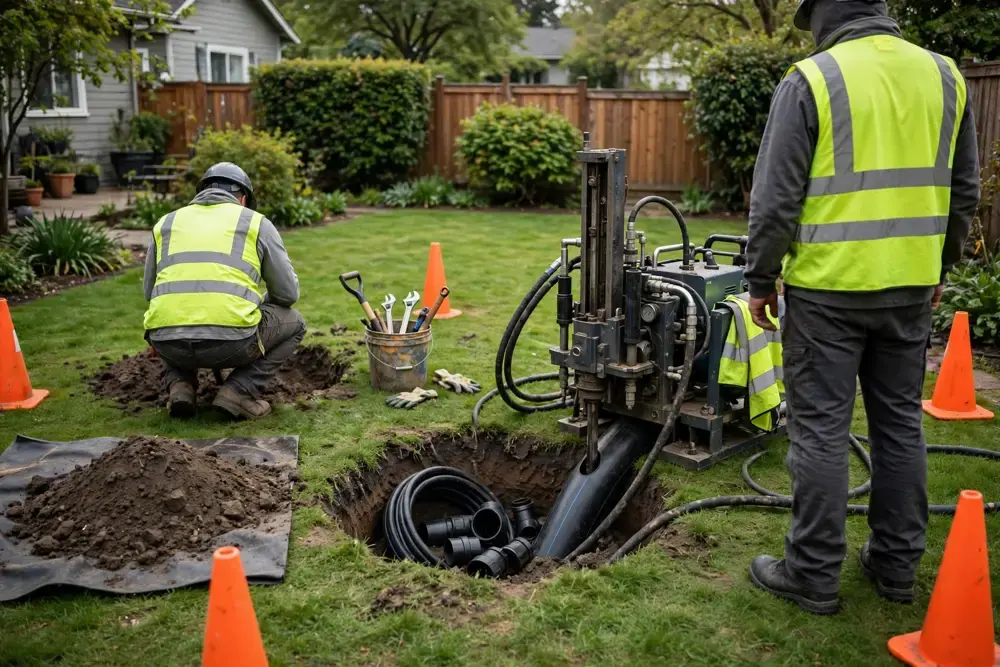
A liner is formed inside the existing line, creating a new pipe within the old one, with access from small entry points rather than a trench.
The old pipe is broken apart while a new pipe is pulled into its place, renewing the line along its existing route.
Entry and exit pits replace a full-length excavation, so landscaping, patios and driveways above the line are largely left alone.
The camera runs the renewed line to confirm it is continuous, correctly connected, and flowing, before the access points are restored.
You keep a short written note on the method used, what the camera showed before and after, and what the rest of the system looks like.
Trenchless repair is often described as no-dig, and the honest version is less-dig: two small access points instead of an open trench, with the work done through the line itself. That distinction matters in Anaheim Hills, where a lateral may run under a landscaped slope, a long driveway or a patio that would be expensive and slow to restore after open excavation. In the flatland tracts the same logic applies wherever a line runs under a driveway or a mature garden.
The limit is just as important as the benefit. Lining needs a line that still holds a shape to line inside; bursting needs a route the new pipe can follow. A collapsed section, a severe belly or a line with the wrong connections may not qualify, and in those cases an open repair or replacement is the honest answer. Sewer-versus-septic coverage varies by street and area, and no ownership or maintenance boundary claim is made for any part of a lateral. Cost depends on length, depth, access, method and material; call (657) 680-4140 for a phone quote.
Five steps, in order, from camera survey to a verified renewed line.
Call and describe it
Tell us the backup history and any previous camera findings. Repeats and footage together point to whether trenchless is even a candidate.
Camera and qualify
We run the camera end to end and assess shape, connections and damage, then say plainly whether lining, bursting or an open approach fits.
Plan the access points
Entry and exit points are chosen to spare landscaping, driveways and patios, and the surface impact is explained before work begins.
Renew the line
The liner is formed inside the old line, or the old line is burst apart as the new pipe is pulled in, following the existing route.
Sewer camera and locator
Surveys the line and marks its route and depth above ground, so access points land exactly where the work needs them.
Hydro jetting machine
Cleans the old line before lining or bursting, at pressure matched to the pipe material, so the new pipe bonds and seats correctly.
Lining equipment
Forms the new pipe inside the old one, sized to the line, with the liner cured in place along the damaged length.
Bursting equipment
Breaks the old pipe apart while pulling the new pipe into its place along the existing route.
Access excavation tools
Opens the small entry and exit pits that trenchless work needs, kept as small as the method allows.
Connection tools
Joins the renewed line to the existing system at both ends, with fittings matched to the pipe and the code.
Qualify before promising
No trenchless method is promised before the camera survey. A line that does not qualify gets an open approach, honestly explained.
Less digging, not magic
Access pits are still dug, and the surface above them is restored. The saving is the trench between them, not the absence of work.
Match method to condition
Lining fits a line that holds its shape; bursting fits a line that needs full renewal along its route. The footage chooses.
Verify the renewed line
Camera and flow checks after renewal confirm continuity and connections before the access points are closed.
01
We camera the line, confirm it holds its shape, and line it from two small access points, leaving the slope and plantings largely untouched.
A renewed line with the landscaping intact, verified on camera before the access points are restored.
02
We assess bursting along the existing route, which renews the line without cutting the driveway open along its length.
A new pipe under an intact driveway, with the work confined to entry and exit pits.
03
We camera the line and, where it qualifies, line the damaged length from access points outside the patio.
A renewed line and an untouched patio, with before-and-after footage kept on file.
04
We explain honestly whether the line qualifies for trenchless renewal, and if it does not, why an open approach is the right call instead.
A decision made from footage, not from a preference for one method — including, when needed, the decision not to go trenchless.
Trenchless methods earn their keep wherever the surface above the line is worth more than the trench: Hills landscaping, tract driveways, Colony patios, and the shared ground of multi-unit buildings.
Hillside lots, landscaped slopes and long driveway crossings, where avoiding a full trench is often the deciding factor for a trenchless approach.
Post-war tracts where laterals run under driveways and front yards, and where a trenchless renewal spares concrete that is expensive to replace.
Historic homes with small lots and patios, where two access points beat an open trench across a carefully kept property.
Multi-unit buildings where a shared line under common ground makes a low-disruption renewal attractive to owners and managers.
Older mixed buildings where laterals run under paved and built surfaces, and where access planning matters as much as the method.
Landscaping and driveways over laterals
In the Hills especially, laterals run under features that open excavation would destroy. Trenchless methods exist for exactly this geometry.
Ageing clay and cast-iron laterals
These lines deteriorate along their length, and trenchless renewal addresses a run, not just one section, where the line qualifies.
Mature trees over older laterals
Roots that entered joints are cleared before renewal, so the new pipe inside or in place of the old line starts clean.
Hillside access and grades
Hillside lots add depth and grade questions to any sewer job. The camera survey answers them before a method is chosen.
Trenchless methods solve run-length problems — deterioration along a line — where the line still allows the method. They do not solve every sewer problem, and the camera is what draws the line.
Problem
A line that has deteriorated along its length, under a slope, garden or patio that would be costly to restore after open excavation.
Our Fix
Lining forms a new pipe inside the old one from small access points, renewing the run while the surface above stays largely intact.
Problem
A lateral that has failed along a driveway crossing, where an open trench would cut concrete along the whole crossing.
Our Fix
Bursting renews the pipe along its existing route, confining the work to entry and exit pits and leaving the driveway intact.
Problem
Joints that have admitted roots along a run, where clearing alone invites return visits and spot repair would mean many excavations.
Our Fix
After roots are cleared, the run is renewed by lining or bursting, closing the entry points along the whole length at once.
Problem
A collapsed section, a severe belly, or connections that trenchless methods cannot handle. Promising trenchless here would be dishonest.
Our Fix
We show the footage, explain why the method does not fit, and discuss the open repair or replacement that actually solves the problem.
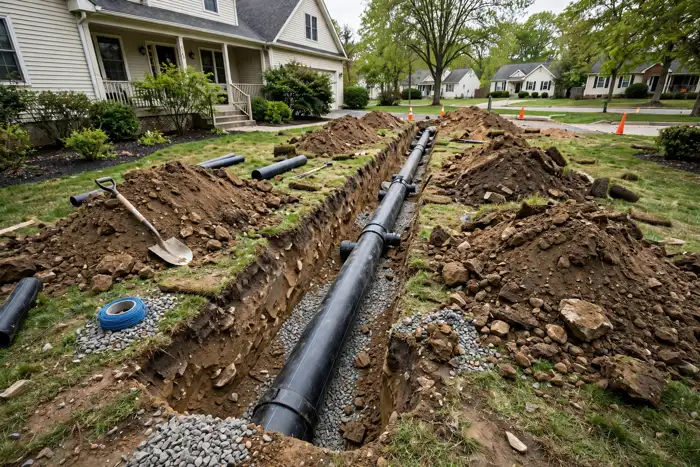
The benefit is simple: a renewed line with the surface above it left alone. The discipline is knowing when that benefit is real and when it is not.
Landscaping and driveways preserved
Two access points replace a full trench, so slopes, gardens, patios and driveways above the line are largely untouched.
A run renewed, not a section patched
Lining and bursting address deterioration along a length, which is the right scale when the camera shows a run, not a spot, that has failed.
Verified on camera
The renewed line is camera-checked before access points are restored, so continuity and connections are confirmed, not assumed.
Honest qualification
A line that does not qualify is told so, with footage. The method follows the line's condition, never the other way around.
Google review — 5 stars
Effortlessly installed our water tank!
Google review — 5 stars
I expected a straightforward process, and that's what happened once coordination with building management was sorted; the plumber installed the new water heater efficiently in about two hours. He made sure to check all connections before leaving, which was reassuring.
Google review — 5 stars
The quote was upfront, and the plumber spent a good hour carefully tracing the leak to an unexpected joint behind a shelf, which was more thorough than my previous experience with another company that missed it entirely. I appreciate that he used a temporary seal until he could return with the proper parts later in the week.
Google review — 5 stars
Unexpected leaks were ruining my morning routine. This plumber arrived on time and swiftly fixed the shower, leaving everything tidy. Their expertise and friendly demeanor made the whole experience stress-free. Highly recommend!
Trenchless work in Anaheim is mostly a Hills story — long laterals under landscaped slopes and driveways — but the same logic applies wherever a tract line crosses concrete or a Colony line crosses a patio. The work is qualifying honestly first: lining where a line holds its shape, bursting where it needs full renewal, and an open approach where neither fits.

Real Google reviews from customers of Master Anaheim Plumbing CA.
Effortlessly installed our water tank!
นางสาวสุรีรัตน์ เครือบคนโท
Google review — 5 stars
I expected a straightforward process, and that's what happened once coordination with building management was sorted; the plumber installed the new water heater efficiently in about two hours. He made sure to check all connections before leaving, which was reassuring.
CLAIRE TURNER
Google review — 5 stars
The quote was upfront, and the plumber spent a good hour carefully tracing the leak to an unexpected joint behind a shelf, which was more thorough than my previous experience with another company that missed it entirely. I appreciate that he used a temporary seal until he could return with the proper parts later in the week.
พิชามญชุ์ กองทอง
Google review — 5 stars
Straight answers to the questions Anaheim homeowners ask most often about trenchless sewer work.
The survey that qualifies a line for lining or bursting — and the verification pass on the renewed line.
View Sewer Camera InspectionA single bad section is a targeted repair. Trenchless renewal is for a run, not a spot.
View Sewer Line RepairWhen a line does not qualify for trenchless methods, open replacement is the honest alternative.
View Sewer Line ReplacementClearing comes before renewal: the old line is jetted clean so the new pipe seats and bonds correctly.
View Drain CleaningA rising bill or damp ground can mean a supply leak, not a sewer problem. Diagnosis separates the two.
View Leak DetectionWhen supply lines are failing on the same timeline as sewer lines, the whole system deserves one plan.
View Repiping ServicesCall (657) 680-4140. We are open 24 hours, Monday–Sunday, and the phone is our only contact channel — there is no email or contact form. Tell us the line's history and any previous camera findings.
Phone
(657) 680-4140Address
1282 S Magnolia Ave, Anaheim, CA 92804
Hours
Open 24 hours, Monday–Sunday