
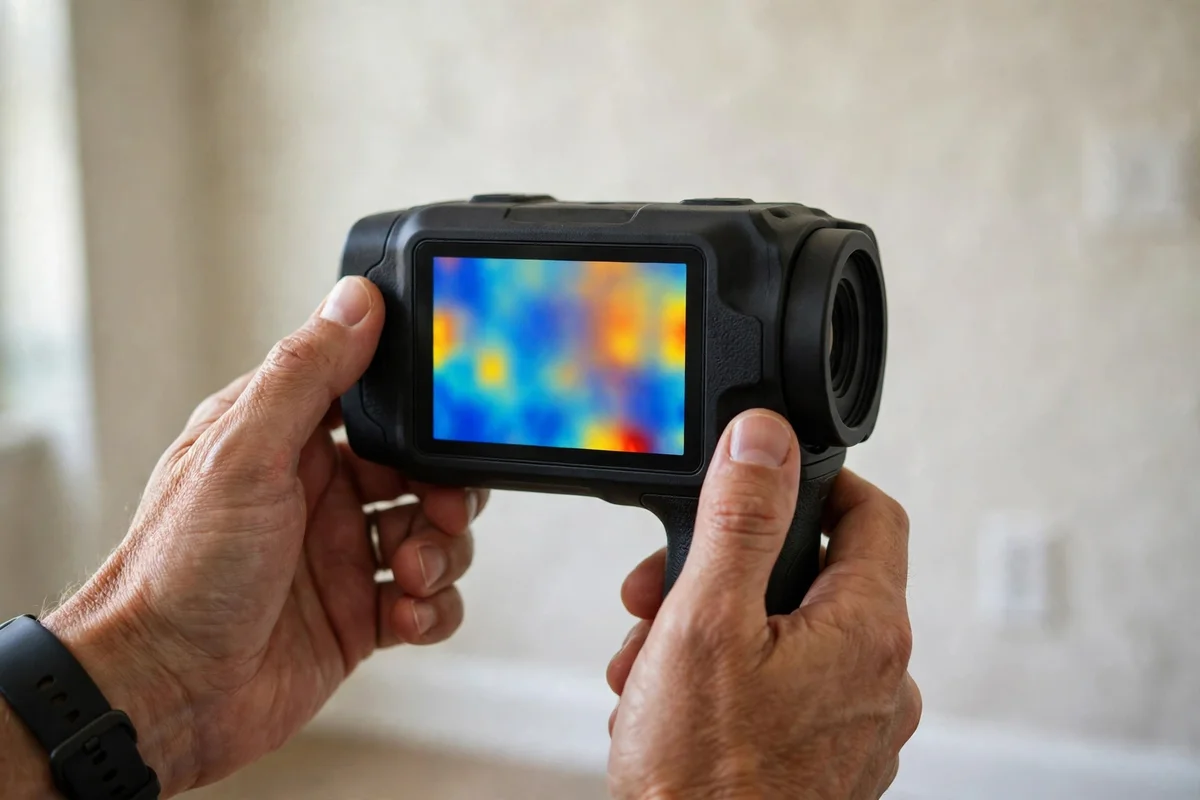
Slab-leak diagnosis
Pressure checks, acoustic listening and thermal checks narrow the leak under the slab to a marked area before any concrete is touched.
Slab work is two jobs, not one: locating the leak under concrete, then choosing between repairing it in place and rerouting around the slab. Both are explained before either is chosen.
Pressure checks, acoustic listening and thermal checks narrow the leak under the slab to a marked area before any concrete is touched.
A leak can be repaired through the slab, or the line can be rerouted around it. The choice turns on the line's age, the leak's position, and how often the line has failed.
Where repair fits, the concrete is opened at the marked location only, the failed section is repaired, and the opening is restored.
Where rerouting fits, a new line is run through walls or overhead, abandoning the failed under-slab section without further concrete work.
Damp carpet, flooring and baseboards are checked, because a slab leak's damage spreads further than its wet spot.
Slab leak repair in Anaheim is a West Anaheim story first, and a flatland story generally. The post-1955 boom filled the flatland with single-storey ranch tracts on slabs, and the supply lines under those slabs — galvanised in the earliest tracts, copper later — have now served for sixty or seventy years in very hard water. Galvanised lines corrode from the inside; copper develops pinhole leaks after decades of hard-water service. Either way, the failure is under concrete, and the first job is always location, never excavation.
The repair-versus-reroute decision is the heart of the page, and it deserves plain language. Repairing through the slab opens concrete at one spot and fixes one failure — right when the line is otherwise sound and the leak is well located. Rerouting abandons the under-slab line and runs a new one through walls or overhead — right when the line has failed before, when its material is near the end of its life, or when opening the slab would do more damage than the reroute. Cost depends on the method, the length, the access and the restoration; call (657) 680-4140 for a phone quote.
Five steps, in order, from symptoms to a repaired or rerouted line.
Call and describe it
Tell us the symptoms: the warm spot, the damp carpet, the bill spike. Each one helps place the leak before the search begins.
Confirm and locate
Pressure checks confirm the leak, acoustic listening and thermal checks narrow it under the slab, and the location is marked.
Discuss repair versus reroute
We explain both options for this leak — in-slab repair or rerouting around the slab — with the reasons each fits or does not.
Repair or reroute
The chosen method is carried out: a spot repair through the slab at the marked location, or a new line run through walls or overhead.
Acoustic listening equipment
Sensitive listening gear picks up water escaping under the slab, narrowing the leak to an area before concrete is touched.
Pressure gauges
Confirm the leak and narrow which branch loses pressure, separating a slab leak from a fixture or wall leak.
Thermal imaging
Reads warm spots on the floor surface, corroborating a hot-line leak's position under the slab.
Moisture meters
Map dampness in carpet, flooring and baseboards, showing how far the leak's moisture has travelled.
Concrete cutting tools
Open the slab at the marked location only, keeping the opening as small as the repair allows.
Reroute pipe and fittings
Run a new line through walls or overhead where rerouting is chosen, matched to the home's system and to code.
Locate before opening
No concrete is touched until pressure, listening and thermal checks agree on a location. Guessing wastes slab and money.
Repair versus reroute, decided openly
Both options are explained for the specific leak, with the line's age and failure history part of the reasoning.
Open only the marked spot
An in-slab repair opens the marked location, not a search pattern. The opening stays as small as the repair allows.
Reroute where the line is done
When the under-slab line has failed repeatedly or its material is spent, rerouting ends the cycle instead of patching it once more.
Phone quote for cost
Method, length, access and restoration drive cost. Call (657) 680-4140 for a phone quote once the leak is located.
01
We confirm the leak by pressure, listen it to a marked area under the slab, and discuss repair versus reroute before any concrete is opened.
A located leak and a chosen method — spot repair or reroute — with the concrete opened only where the method requires.
02
We map the moisture, confirm the loss at the meter, and locate the under-slab leak behind the damp area, separating it from a drain or appliance source.
A proven slab leak, located and marked, with the damp area's full extent mapped for drying and repair.
03
We lay out the reroute option honestly: a second in-slab repair patches a line that has already shown it will fail again, while a reroute ends the cycle.
A rerouted line through walls or overhead, with the failed under-slab section abandoned and the cycle broken.
04
We check whether the hollow sound and dampness trace to an under-slab supply leak, using pressure and listening before any floor is lifted.
A confirmed or ruled-out slab leak, with the next step — repair, reroute, or a different system's fix — stated plainly.
Slab leaks belong to the flatland tracts first: West Anaheim above all, then the other 1950s–1960s slab neighbourhoods, with the Colony's mixed construction as the contrast case.
The signature slab-leak neighbourhood: 1950s–1960s slab tracts with ageing supply lines under concrete, where warm floors, damp carpet and bill spikes are the classic symptoms.
Later tract development on slabs, where the same ageing-line story plays out in slightly younger homes with the same symptoms.
Tract housing of the same flatland era, where slab leaks hide under concrete and show only through floors, carpets and bills.
Older homes near the civic core, where slab construction mixes with earlier foundations — and where the search must first establish what is actually under the floor.
The contrast case: the city's oldest homes, where crawlspace and mixed construction change the search entirely, and where a 'slab leak' may not be a slab leak at all.
1950s–1960s slab tract construction
Single-storey ranch tracts on concrete slabs, with supply lines under the concrete — the housing pattern that makes slab leaks an Anaheim signature.
Ageing galvanised and copper under-slab lines
Galvanised lines corrode from the inside; copper pinholes after decades in very hard water. Both fail quietly, under concrete.
Very hard water
Anaheim's water is very hard, and decades of hard-water service are the background cause behind most under-slab failures.
Warm floors, damp carpet, bill spikes
The symptom trio of a slab leak: a warm spot from a hot line, dampness where water reaches the surface, and a bill that jumps with no change in use.
Slab leaks present as symptoms, not as visible water. Each symptom points to the same hidden failure, and each needs location before repair.
Problem
A warm patch on a slab floor usually means a hot-water line leaking under the concrete, warming the slab from below.
Our Fix
We confirm by pressure, locate by listening and thermal checks, mark the spot, and discuss repair versus reroute before opening anything.
Problem
Carpet or flooring that stays damp, or baseboards that swell, can mean an under-slab leak reaching the surface far from its source.
Our Fix
We map the moisture, confirm the leak, locate it under the slab, and target the repair at the marked location.
Problem
A bill spike with no change in use is often the first sign of an under-slab leak, and the meter is the first witness.
Our Fix
We check the meter with fixtures off, pressure-test the system, and listen the leak to its under-slab location.
Problem
A second or third failure in the same under-slab run means the line, not one spot, is done. Another spot repair only schedules the next opening.
Our Fix
We recommend rerouting honestly, running a new line through walls or overhead and abandoning the failed under-slab section.
A slab leak is the job where guessing costs the most: every wrong opening is concrete, flooring and money. Location first, method second, is the whole discipline.
Location proven before concrete is touched
Pressure, listening and thermal checks must agree before any slab is opened, so the opening lands on the leak.
Repair versus reroute, decided openly
Both options are explained for the specific leak, with the line's age and failure history in the open, not buried in a quote.
Openings kept as small as the repair allows
An in-slab repair opens the marked location only. A reroute avoids the slab altogether. Either way, the damage is minimised.
West Anaheim tract knowledge
The 1950s–1960s slab tracts are where this work concentrates, and the search starts from their construction, not a generic routine.
Google review — 5 stars
I expected a straightforward process, and that's what happened once coordination with building management was sorted; the plumber installed the new water heater efficiently in about two hours. He made sure to check all connections before leaving, which was reassuring.
Google review — 5 stars
The quote was upfront, and the plumber spent a good hour carefully tracing the leak to an unexpected joint behind a shelf, which was more thorough than my previous experience with another company that missed it entirely. I appreciate that he used a temporary seal until he could return with the proper parts later in the week.
Google review — 5 stars
Unexpected leaks were ruining my morning routine. This plumber arrived on time and swiftly fixed the shower, leaving everything tidy. Their expertise and friendly demeanor made the whole experience stress-free. Highly recommend!
Google review — 5 stars
Fixed my leaking pipe efficiently.
Slab work concentrates in West Anaheim and the other flatland tracts, where 1950s–1960s lines under concrete have served for sixty or seventy years in very hard water. The discipline is location first — pressure, listening, thermal — then an open decision between spot repair and reroute, made from the line's age and failure history rather than from habit.
Real Google reviews from customers of Master Anaheim Plumbing CA.
I expected a straightforward process, and that's what happened once coordination with building management was sorted; the plumber installed the new water heater efficiently in about two hours. He made sure to check all connections before leaving, which was reassuring.
CLAIRE TURNER
Google review — 5 stars
The quote was upfront, and the plumber spent a good hour carefully tracing the leak to an unexpected joint behind a shelf, which was more thorough than my previous experience with another company that missed it entirely. I appreciate that he used a temporary seal until he could return with the proper parts later in the week.
พิชามญชุ์ กองทอง
Google review — 5 stars
Unexpected leaks were ruining my morning routine. This plumber arrived on time and swiftly fixed the shower, leaving everything tidy. Their expertise and friendly demeanor made the whole experience stress-free. Highly recommend!
Maria Johnson
Google review — 5 stars
Straight answers to the questions Anaheim homeowners ask most often about slab leaks.
Hidden leaks elsewhere in the home — walls, fixtures, branches — use the same prove, isolate and listen discipline.
View Leak DetectionWhen under-slab lines fail repeatedly, a whole-home repipe — often via reroutes — becomes the wider answer.
View Repiping ServicesDamp ground or a backup with no supply-leak evidence can mean a sewer problem. The camera separates the two systems.
View Sewer Camera InspectionA leak between the meter and the home, or a meter spinning with fixtures off, points to the main line instead.
View Main Water Line RepairA slab leak that is actively flooding is an emergency first: stop the water, then locate.
View Emergency Plumbing ServicesSlow drains alongside dampness can confuse the picture. Clearing and camera work separate drain problems from supply leaks.
View Drain CleaningCall (657) 680-4140. We are open 24 hours, Monday–Sunday, and the phone is our only contact channel — there is no email or contact form. Tell us the symptoms and the home's era if you know it.
Phone
(657) 680-4140Address
1282 S Magnolia Ave, Anaheim, CA 92804
Hours
Open 24 hours, Monday–Sunday